
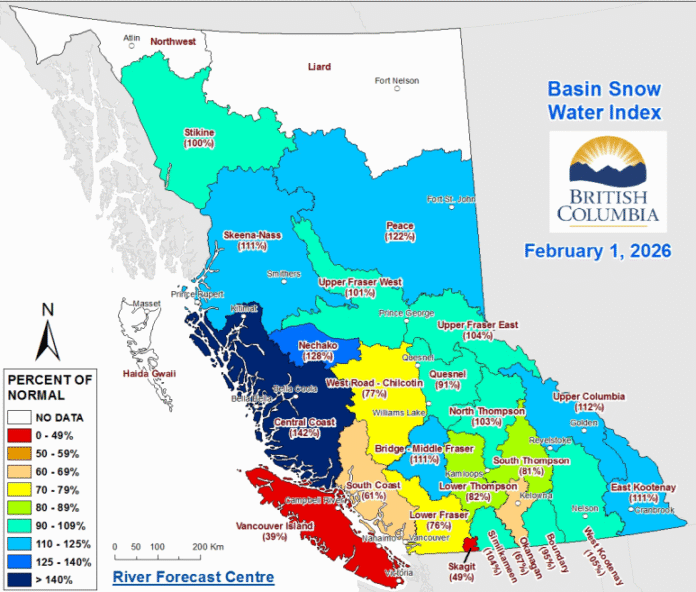

Updated data from the province’s Snow Basin Index show Vancouver Island snowpacks are the lowest in B.C. as of Feb. 1.
February’s Snow Survey and Water Supply Bulletin pegs the local snowpack at 39 per cent of its seasonal average, while the South Coast, which includes the Sunshine Coast, is at 61 per cent of normal for this time of year.
The province said a below-normal snowpack could signal potential drought conditions through the warmer months.
“Areas with below normal snowpack show early concerns for drought conditions amplifying in the spring and summer,” reads a statement from the province’s Snow Basin Index report for February.
The report said B.C. normally experiences two thirds of its annual snow accumulation by February.
Province-wide, snowpacks are at 96 per cent of the seasonal average, with the Nechako region having the highest levels at 128 per cent.
“There are still two or three months remaining in the snow accumulation season, and snowpack can change significantly depending on upcoming weather patterns,” the report said.
It adds that warmer weather and heavy rain in January in the Vancouver Island and South Coast regions contributed to snowmelt at lower elevations.
“This was followed by a shift to more stable weather, with a strong high-pressure ridge developing over the eastern Pacific and ushering in a prolonged period of warm and very dry conditions,” the province said.
The February Snow Basin Index update is available here.
– Article includes link and image supplied by Province of British Columbia